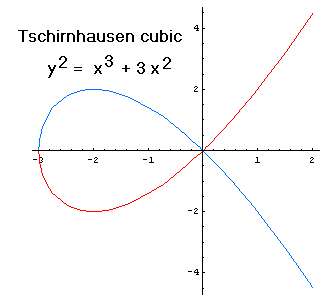
As an example of implicit differentiation, we study the
Tschirnhausen cubic.
Since each value of x
in the interval x > -3 except x = 0 corresponds
two different y-values, the cubic does not determine
y as a function of x. The colors in the drawing
are meant to suggest one way in which we could divide the cubic
into two parts, each of which determines y as
a function of x in a different way. But this way of
dividing the cubic is not the only possible one; to draw this
cubic, I instructed my computer algebra system to draw the graphs
of the two functions shown here:
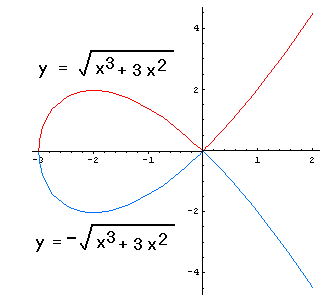
Unlike the two functions in the first picture, these two functions are not differentiable at 0; but they have simple expressions in terms of familiar functions. However the cubic is divided, though, if we focus on a sufficiently small part of the curve, except (-3,0) and (0,0), y appears as a differentiable function of x. In this sense, we say that the equation of the cubic determines y "implicitly" as a function of x (as opposed to an "explicit" definition of y as a function of x). Suppose we want to find the derivative dy/dx of the function at one of these many "good" points. For this cubic, since it is possible to express the functions explicitly (as written on the graph), we need not use implicit differentiation. But for many curves explicit solutions are not available, so let us try something else. Granting that y is (locally) a function of x,, both sides of the defining equation y2=x3+3x2 are functions of x, indeed, the same function of x because they are equal. So their derivatives are equal also. Now, although we are avoiding the explicit expression of y in terms of x, we can still use the Chain Rule to write an expression for the derivative with respect to x of the left side of the equation, which must equal the derivative of the right side:
Solving this for dy/dx gives an expression for the derivative in terms of both x and y:
It should not be surprising that both variables are needed,
because the point on
the curve is not uniquely determined by x alone.
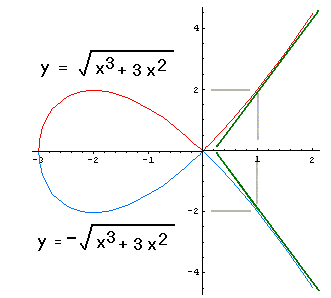
For example, the tangents at the two points with
x-coordinate 1 on this cubic have different slopes:
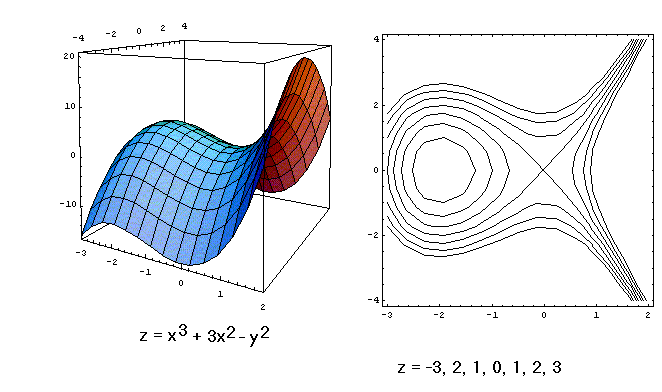
Picking values for z just amounts to slicing this graph
with horizontal planes, forming "contours" of the surface.
The plane z=0 gives the present cubic; others, for
z=-3,-2,-1,1,2,3, have no crossing points (called
nodes, as at (0,0) in the original cubic), though for some
the graph is disconnected (when the slicing plane is above the
origin but not above the "dome" that has high point at
(-2,0,4)):
At any point on any one of these curves, we can use the formula
to find the slope of the tangent line. For instance,
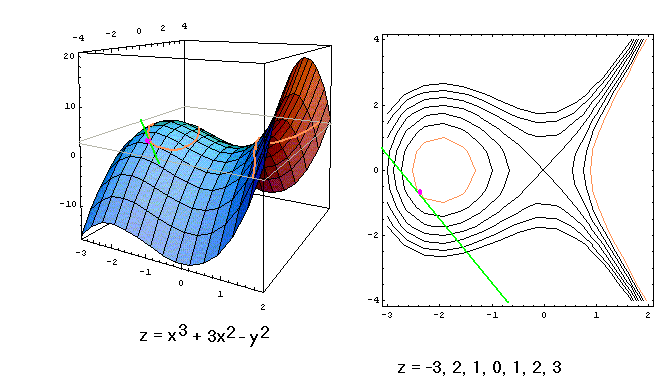
the plane z = 3 (outlined in gray) intersects the surface
in the disconnected orange curve, including the violet point with
coordinates z = 3, x = -2.4, and y equal
to the negative square root of .456 (roughly -0.68). The light
green tangent line to the orange curve at the violet point in
the gray plane has slope given by the formula:
or about -2.1. (The difference in the horizontal and vertical scales in the left picture is a bit misleading. Note that for every horizontal increase of 1 unit, the vertical decrease along the light green line is roughly 2 units.)