MATH 323: Real Analysis I
TEXT: Stephen Abbott,
Understanding Analysis, Springer-Verlag, 2001. ISBN 0-387-95060-5.
INSTRUCTOR: David Lantz
- Email: dlantz@colgate.edu
- Office : McGregory 316 ----- Extension : 7737
- Formal Office Hours : 11:20-12:10 MWF and 2:20-3:10 MW
- Effective Office Hours: Weekdays, 9:00-4:30, except
when I am teaching (10:20 and 12:20 MWF) or in a meeting
WEB ADDRESS: This page has the web address:
http://math.colgate.edu/math323/dlantz/realsfdi.html
I encourage you to bookmark it in your browser for later use.
HOMEWORK: Due dates will be specified.
Homework must be typed.
- Page 17 (Ch 1, sec 3): 1.3.3(a), 1.3.4, 1.3.5, 1.3.6, 1.3.7
(easy), 1.3.8 (very easy), 1.3.9; and page 27 (Ch 1, sec 4):
1.4.2(c), 1.4.4. Due date Fri 9 Sep.
- Page 43
(Ch 2, sec 2): 2.2.1, 2.2.2, 2.2.6, 2.2.7, 2.2.8. Due Wed 14 Sep.
- Page 49 (Ch 2, sec 3): 2.3.1, 2.3.2 (For (b), assume
x is not 0.), 2.3.3 (If a<b<c,
then |b|<max{|a|,|c|}.), 2.3.4 (Assume not, and
take as epsilon half the distance between the "limits". The
Triangle Inequality is helpful.), 2.3.6, 2.3.8, 2.3.9, 2.3.10,
2.3.11 (After choosing N large enough to make the
xn's close to their limit x, choose
N1 still larger so that
(|x1-x| + ... +
|xN-x|) / N1
is small.). Due date Wed 21 Sep.
- Page 54 (Ch 2, sec 4): 2.4.2 (For (a), note
x2-4x+1<0 is equivalent to
(x-2)2<3.), 2.4.4, 2.4.5(a) (Use
(xn-21/2)2>0 to show
xn+1>21/2.); and page 58 (Ch 2,
sec 5): 2.5.3. Due date Mon 26 Sep.
- Page 61 (Ch 2, sec 6): 2.6.1, 2.6.3, 2.6.4; and page 68 (Ch
2, sec 7): 2.7.4 (easy), 2.7.5, 2.7.9, 2.7.10. You may use among
your examples the fact that ∑ 1/n2
converges. Due date Wed 5 Oct.
- Supplementary exercises on
the convergence of infinite series. Due date Fri 14 Oct.
- Page 82 (Ch 3,
sec 2): 3.2.1, 3.2.2, 3.2.3, 3.2.7, 3.2.9, 3.2.12 (and read
3.2.8); and page 87 (Ch 3, sec 3): 3.3.1, 3.3.3, 3.3.4, 3.3.5,
3.3.7, 3.3.9. (Exercise 3.3.6 is an interesting fact, but we
probably won't use it.) Due date Wed 19 Oct.
- Page 108 (Ch 4, sec 2): 4.2.1(a), 4.2.6, 4.2.9; and page 113
(Ch 4, sec 3): 4.3.2, 4.3.3, 4.3.5, 4.3.9 (For (b), verify that,
if m> n, then
|ym-yn| is at most
|y2-y1|(cn-1/(1-c)).
For the first part of (c), assume BWOC f(y) is different
from y, and use the Triangle Inequality on |f(y) -
f(yN) + f(yN) - y|.)
Due date Mon 7 Nov.
- Page 119 (Ch 4, sec 4): 4.4.2, 4.4.4, 4.4.8 (Note f is
uniformly continuous on [0,b+1].), 4.4.9; and page 124 (Ch
4, sec 5): 4.5.3, 4.5.7 (Set g(x)=f(x)-x.). Due date Mon
14 Nov.
- Page 136 (Ch 5, sec 2): 5.2.1, 5.2.2, 5.2.4; and page 143 (Ch
5, sec 3): 5.3.1, 5.3.2, 5.3.5, 5.3.7 (For the last part of (b),
evaluate g' at 1/(k π) for each natural number
k.), 5.3.11. Due date Mon 21 Nov (accepted Fri 18 Nov).
- Page 190 (Ch 7, sec 2): 7.2.2, 7.2.3, 7.2.4, 7.2.6 (Hint: Use
the partition of [a,b] into n subintervals of equal
length and apply Exercise 7.2.4(a).); and page 193 (Ch 7, sec 3):
7.3.1 (Typo: The function should be f, not h.),
7.3.4(c), 7.3.5. Due date Fri 2 Dec.
- Page 198 (Ch 7, sec 4): 7.4.1, 7.4.2, 7.4.4 (For (d) in
particular, go to the definition of integral.), 7.4.5 (In the
proof of (b), show L(f,P) + L(g,P) is at most
U(f+g,P).) Due date Mon 5 Dec.
- Page 201 (Ch 7, sec 5): 7.5.1, 7.5.2, 7.5.4 (In (c),
integrate 1/t from c to cx by the
substitution u=t/c.), 7.5.7, 7.5.9. Due date Fri 9 Dec.
To get to the index page for the solutions, type the code word in
the box, then click the button:
TESTS: There will be three mid-term exams, on
Tuesday evenings, 7:30-9:30 p.m., September 27, October 25 and
November 29, in our usual classroom, McGregory 215. A cumulative final
exam will be given during the officially scheduled final exam period
for this course, Friday, December 16, at 9:00 a.m. If it is impossible
for you to take one of the
mid-terms during the scheduled period, please see me to set a time
to take it early, ahead of the scheduled period.
The date and time for the final cannot be altered; consider before
making travel plans.
GRADING: Homework will be worth one-fifth of the
course grade, and each exam (including the final) will be worth
one-fifth of the grade.
SIGNIFICANT DATES:
- Mon Aug 29: First class (short session)
- Tue Sep 27: First midterm exam, 7:30 pm
- Tue Oct 25: Second midterm exam, 7:30 pm
- Tue Nov 29: Third midterm exam, 7:30 pm
- Fri Dec 9: Last class
- Fri Dec 16 : Final exam, 9 am
SUGGESTIONS:
- If you see an error at the board, or if you do not understand
something, stop me and ask (even if everyone else seems to
understand).
- Doing the homework, regularly and
thoughtfully, is absolutely essential to your success in the course.
STUDY AIDS AND GRAPHICS:
- Class notes from Chapter 1
- Class notes from Chapter 2
- Class notes from Chapter 3
- Class notes from Chapter 4
- Class notes from Chapter 5
- Class notes from Chapter 7
- Class notes from Chapter 6
- Exam I from an earlier semester, with solutions
- This semester's Exam I, with solutions
- Exam II from an earlier semester, with solutions
- This semester's Exam II, with solutions
- Exam III from an earlier semester, with solutions
- This semester's Exam III, with solutions
- Final Exam from an earlier semester, with solutions
- This semester's Final Exam, with
solutions
- Proof of Euler's sum of
1/k2
- An
example of: "Given epsilon, find delta".
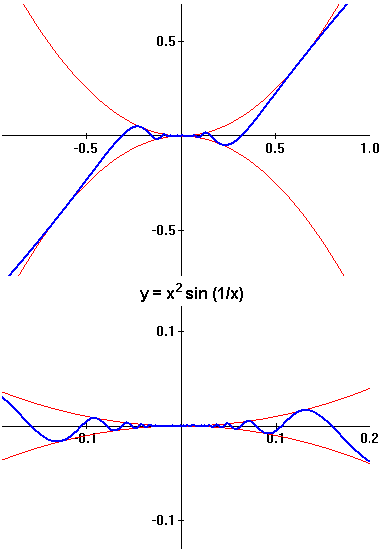
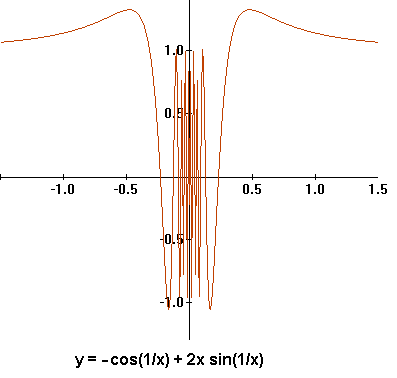
- A differentiable function with a
discontinuous derivative ... and
its derivative
- "If set A is ..., then
f(A) (or f -1(A)) is ..."
- Definition of the definite integral
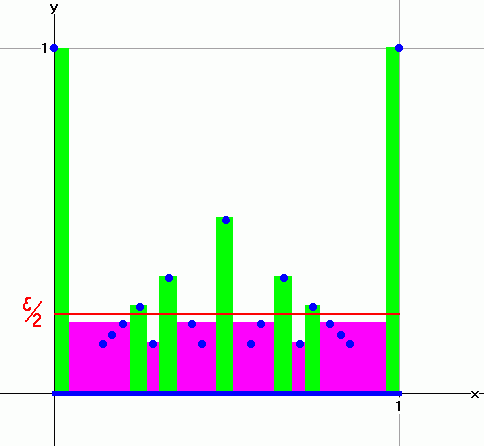
- Upper integral of the Thomae
function
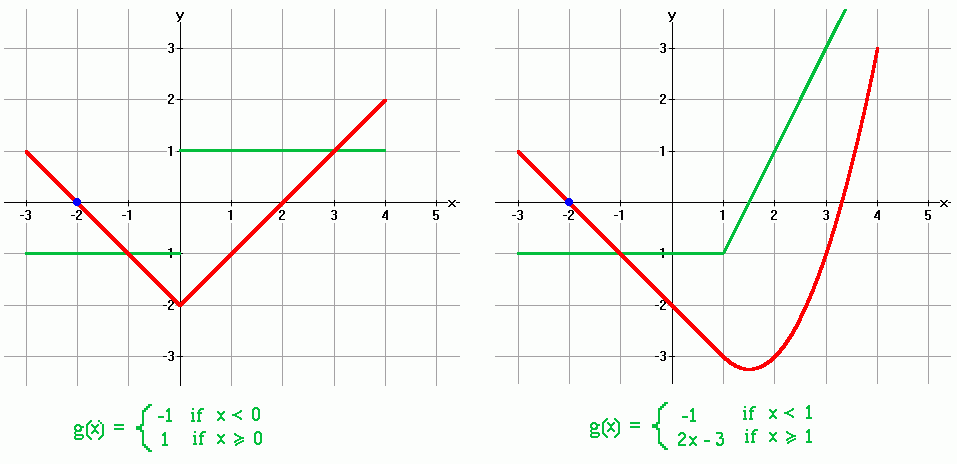
- Functions defined as integrals
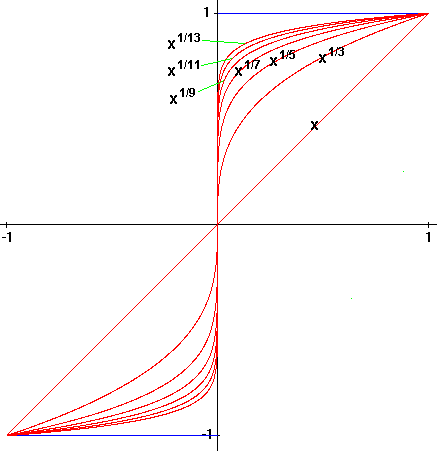
- A discontinuous limit of continuous
functions
Revised: December 16, 2011. Questions to: dlantz@colgate.edu
Copyright 2011 © Colgate University. All rights reserved.